Konèksyon•Connection

This form does not yet contain any fields.
    Sunday
    May202012

    Partners in deforestation and slumification

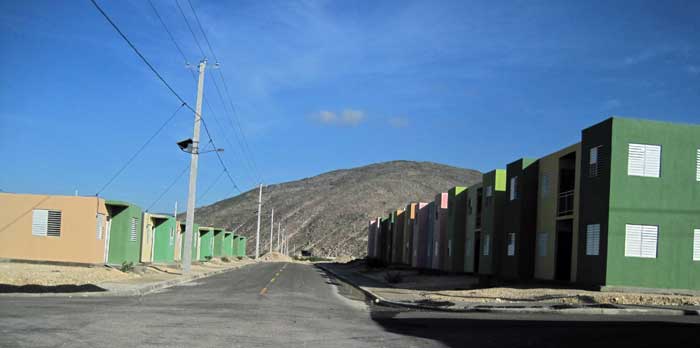
    Port-au-Prince, 21 May 2012 –  Working together with a local official, two humanitarian institutions have – unwittingly or not – contributed to the deforestation of part of Morne L’Hôpital, a mountain that overlooks the capital and which is under special environmental protection.

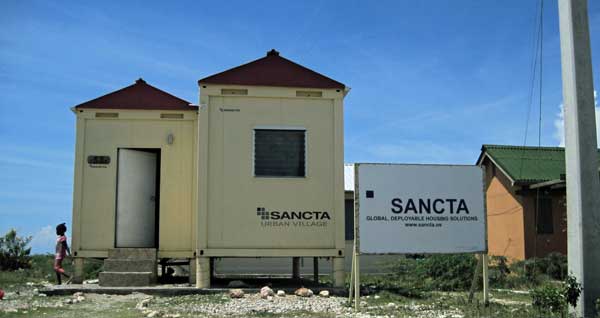
    An investigation by Haiti Grassroots Watch (HGW) in the Upper Turgeau region of Port-au-Prince discovered that about 100 “transitional shelters” ­­– often called “T-Shelters” –were donated to earthquake victims and built in places where, prior to the 2010 catastrophe, there were trees, bushes, or at the very least, no houses. Today, thanks to the donations of the 12-by-18 square meter wooden shacks, an illegal slum has grown, and the slopes above Port-au-Prince are even more denuded.

    New slum on Morne L'Hôpital, comprised mainly of T-Shelters donated by NGOs.
    Photo: Evens Louis

    Humanitarian organizations Agency for Assistance in Development and Technical Cooperation or ACTED (in French: the Agence pour la coopération technique et au développement) and GOAL assisted at least 100 displaced families by constructing little houses in green spaces in the protected area. The mountain slope – which cuts through parts of Pétion-ville, Port-au-Prince, and Carrefour – is covered by a 1963 law and a 1986 decree which stipulate that the slope should be specially protected.

    One of the institutions – GOAL – was funded by the US government for the project. The other – ACTED – by the American Red Cross.

    Two new homes where before there were none. On the left, ACTED-built, on the right, GOAL-built. Photo: Evens Louis

    The laws set forth a whole series of rules regarding what is permitted, and what is not, on the slope. The government agency Organism for the Oversight and Planning for Morne L’Hôpital or OSAMH (in French: Organisme de Surveillance et d’Aménagement du Morne l’Hôpital) is tasked with overseeing the protected zone.

    Nevertheless, the two non-governmental organizations (NGOs), who both admit knowing about the protected status of the region, built T-Shelters there, in part thanks to assistance from the president of the Turgeau Communal Council Board (CASEC), engineer Raoul Pierre-Louis.

    (In Haiti, each “commune” – a subdivision of the “department” or province, is divided into “communal sections.” According to the 1986 Constitution, each communal section is supposed to have an assembly – like a mini-parliament – and an executive committee or board of three. The assemblies have rarely functioned and so in many instances, the executive council is chosen by the central government or is elected directly. Pierre-Louis was elected, but like all over CASECs and mayors, his term has expired.)

    “Because of the destruction of homes caused by the earthquake, we needed to see how, temporarily, we could find a way to rehouse people,” remembered Fredly Anténor, coordinator of the construction team for the Irish NGO GOAL.

    ACTED and GOAL are just two of the many NGOs that built T-Shelters to help families leave the sordid refugee camps set up after the earthquake. Despite the fact that many actors criticized the focus on T-Shelters as a response to the emergency situation created by the 1.3 million displaced people [see Abandoned Like A Stray Dog], several dozen humanitarian institutions built over 110,000 of the little supposedly temporary houses for a total cost of US$500 million.

    An ACTED T-Shelter in a formerly green space. Photo: Evens Louis

    Over at ACTED, Marianna Franco, head of the development program which built 28 T-Shelters on Morne L’Hôpital, gave much the same explanation: “When the idea for T-Shelters came along, there wasn’t any kind of urban development plan for Port-au-Prince or the metropolitan area. There still isn’t! So, we built T-Shelters where we could find space.” 

    According to Franco, her agency worked with the CASEC and made sure that all T-Shelter beneficiaries had property titles. However, according to CASEC president Pierre-Louis, ACTED did not follow correct procedures.

    The “weak state” in plain view

    A law – published in the official government journal Le Moniteur on November 6, 1986, is very clear about Morne L’Hôpital:

    “Residential construction is not permitted unless permission is obtained from the relevant agencies… [Article 9]

    “It is not permitted to graze cows or goats; to cut any wood or bush, to undertake any kind of planting that involves hoeing… or do any kind of burning for whatever reason.” [Article 11]

    But plots were cleared, trees cut, and foundations prepared for at least 100 of the new little houses, and probably more.

    A slope near the protected zone, where clearly someone or some agency has
    protected the left portion, indicating that it is possible to keep people from
    building on the fragile hillsides surrounding the capital.
    Photo: Evens Louis

    The director of OSAMH, agronomist Montus Michel, recognizes that his agency is weak. He lacks the necessary human resources, financial resources, and also authority in the field.

    “The state can’t really intervene [at Morne l’Hôpital] without the accompaniment of the police and representatives of the justice system. It’s written in the law. When OSAMH wants to go into the field, its agents should be escorted by someone from the legal system,” he said.

    While the law might state that imperative, the reality is different. Agents work on their own.

    “As far as surveillance and control of activities at Morne l’Hôpital go, and as far as protecting the ecosystem goes, OSAMH is very weak, but this is due also to the general weakness of the state,” Michel admitted.

    A sign of that “weakness?”

    GOAL said it did indeed know that the region was protected, and that the agency OSAMH was responsible for overseeing it. GOAL representatives also said that they met with an OSAMH agent.

    “We worked with OSAMH starting from the beginning. OSAMH is the one that gave us the geographic limits of where we could build,” Fredly remembered, and one of his colleagues added that the agent’s name was Canez Dellande.

    OSAMH director Michel rejected the statement.

    “GOAL?” he asked. “That is a total lie.”

    “We never delegated anyone to work with them. We could never send an engineer out to set the limits if the NGO didn’t first give us a plan that outlined their activity… Canez doesn’t have the right to do that kind of work, to meet with representatives of an NGO in order to allow them to work on Morne l’Hôpital. That relationship is supposed to be institution to institution,” the director said.

    But Michel also recognized that his agent never told him about the initiative.

    In the meantime, it appears that the NGO ACTED worked on its own, because Michel said he never met with any representative of that institution either.

    Another state institution…

    In addition to reportedly working with an OSAMH agent, GOAL representatives said they collaborated closely with CASEC president Pierre-Louis, who is in fact another representative of the state.

    “We built a total of 2,483 T-Shelters [in the 6th communal section of Turgeau],” Pierre-Louis said. “There is a signed document for all the shelters that GOAL built. The same goes for CORDAID and IOM [two other organizations that built T-Shelters in Turgeau].”

    “All of the Upper Turgeau T-Shelters were built with the permission of the CASEC,” GOAL country director Derek Butler confirmed.

    And, according to both Butler and Pierre-Louis, all the T-Shelters were built in spots that held houses before.

    But HGW investigations revealed the contrary. At least 100 little homes were built in places that previously before had no construction.

    When confronted with this truth, Pierre-Louis rejected the statement, and then added, “in any case, they are temporary. They need to be moved.”

    But that seems unlikely.

    From temporary to permanent

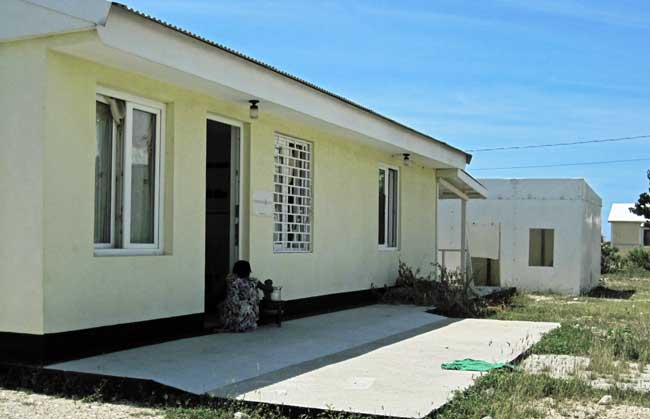
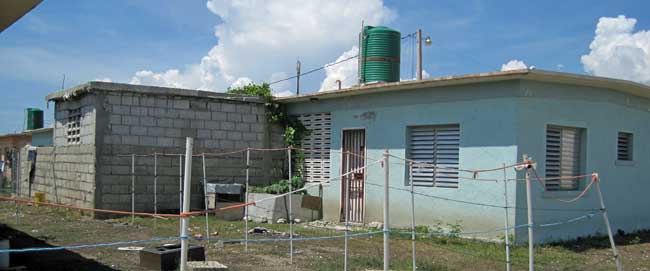
    All over the country in the earthquake-affected zones, T-Shelter recipients are busy converting the shacks into permanent homes with concrete walls, extra rooms and other additions.

    When questioned, GOAL said it was aware of the phenomenon.

    “When you build a temporary shelter for someone, it is very likely that it will become permanent. We have seen people doing the transformation,” a GOAL agent admitted to Pierre-Louis during a telephone call for which HGW was present. “Therefore, we said to ourselves, ‘Let’s see how we can help these people turn their temporary shelters into permanent homes.’”

    A family in the process of converting their GOAL T-Shelter into a permanent home.
    The foundation has been prepared and the flimsy iron rods indicate where the walls
    will be.
    Photo: Evens Louis

    In an interview with HGW, ACTED said much the same.

    Pierre-Louis was visibly displeased.

    “We signed papers that say ‘shelter’ not ‘house,’” he told HGW. “We have a land ownership problem. That land does not belong to the displaced people. You cannot build a permanent home in a place that does not belong to you.”

    Who has the power to protect and to decide?

    When it comes to the case of the T-Shelters built in formerly green spaces on Morne l’Hôpital, it is clear that two state authorities – CASEC president Pierre-Louis and OSAMH – failed in their mission to respect and assure respect for the law.

    But, there is also another authority implicated in the expansion of the slum on Morne l’Hôpital.

    The GOAL T-Shelters were built with money from the US government, from the Office of US Foreign Disaster Assistance (OFDA). Parallel to that grant, however, and ironically, immediately after the earthquake another agency – the US Agency for International Development (USAID) – published a document announcing that the catastrophe had created an opportunity to protect the zone.

    “The steeply sloped Morne l’Hôpital benefits, at least theoretically, from its special legal status as a ‘public utility,’ a protected area off limits to construction,” notes the document, which also says USAID partners with OSAMH. “The post-earthquake period provides an unprecedented opportunity to assert control over Morne l’Hôpital as a legally protected zone and prevent new housing construction on fragile slopes.”

    HGW requested, without success, an interview with USAID’s Haiti office in order to better understand why one US agency financed the deforestation of Morne l’Hôpital while another suggested the exact opposite.

    HGW also wrote to the USAID supervisory office in El Salvador, but received no response.

    OSAMH director Michel does not deny the responsibility of the government in the expanding slumification, or in the continued construction of the homes by the well-to-do in the protected area. But the agronomist also feels that certain NGOs are irresponsible.

    This T-Shelter-turned-corner store is selling charcoal. Was it made on Morne L'Hôpital?
    The store is called "God is Good" but in this case, it appears ACTED was "good," also.

    Photo: Evens Louis

    “We can’t stop the NGOs from doing work inside the 2,000 hectares… But they should be follow the law and meet with OSAMH to see how things out to be done,” Michel said. “Because, if we let NGOs come, independent of OSAMH, and help increase the slums on Morne l’Hôpital, well, that is very bad for the country.”

    As for Pierre-Louis, he said, cynically: “The slumification of Port-au-Prince has just started.”

    “The problem isn’t the slums, but its when the slums stay slums for too long,” he added. Pierre-Louis sees slums as a natural phase in “the process of urbanization.”


    Kettie Guerrier and Milo Milfort for Haiti Grassroots Watch

    This report made possible with the support of the Fund for Investigative Journalism in Haiti

    Haiti Grassroots Watch is a partnership of AlterPresse, the Society of the Animation of Social Communication (SAKS), the Network of Women Community Radio Broadcasters (REFRAKA), community radio stations from the Association of Haitian Community Media and students from the Journalism Laboratory at the State University of Haiti.

    Tuesday
    Apr172012

    Liquid Death

    Part 1 of 2

    17 April 2012

     In early 2011, a dozen people died after drinking “clairin” – a traditional Haitian alcohol drink – made with methanol in the Fond Baptiste region, north of the capital. Another 20 or so were blinded or paralyzed.

    One year later, Haiti Grassroots Watch (HGW) exposes that judicial, health and commerce authorities have not investigated who was responsible for the tragedy. The production and sale of clairin – and “fake clairin” – continues with no regulation. The tragedy could occur again at any moment, on an even larger scale.

    Lack of political will? Incompetence? The results are the same.

    “It’s like my guts were ripped out.”

    That’s how Michaelle Hilaire remembers it.

    “I took my cousin to the hospital. While I was waiting at the gate, he died in my arms. When I came home that Wednesday, they told me my brother was ill. I burst into tears. The next day, he was dead. And then, my husband died…. My cousin died, my brother died, my man is dead."

    Mother of six, Michaelle Hilaire is one of a group of women from Fond Baptiste, in the mountains above the capital, suddenly widowed or made the wife of a paralyzed or blinded man.

    In February 2011, a Fond Baptiste woman died suddenly after drinking clairin – a traditional Haitian alcohol made from sugar cane. In the days that followed, at least 11 others died, and more than 20 others in the same region or in nearby Lully and Lafiteau – most of them men – were made blind or paralyzed.

    The national and international health authorities were notified and after field visits, they wrote a report pinpointing a “false clairin,” made from or mixed with methanol, a toxic alcohol generally used as a solvent.

    “The tests on patients’ blood samples and on two samples of the alcohol confirmed that methanol is responsible for the poisoning of the residents of Fond Baptiste and neighboring regions,” a February 18, 2011, report said.

    Another report from the same period, by Cuba’s National Toxicology Center, laid out the gravity of what had just occurred in the tiny mountain village:

    “Methyl alcohol or wood alcohol [is]… the simplest of all alcohols. It is a clear and volatile liquid, with an odor that resembles ethyl alcohol. It is used as an anti-freeze, as a gum solvent, and also in the fabrication of organic products.”

    “It is sweeter and much more sugary tasting than ethanol,” Dr. Ancio Dorcélus told HGW in a recent interview. Dorcélus saw the results of that sweetness first hand. He treated some thirty people who had been poisoned, but not killed, at his Arcahaie clinic.

    A year later, but like yesterday…

    The widow Hilaire doesn’t hide her emotions when talking about her three deceased family members. Tears in her eyes, she tries to remember those days that sunk her household into darkness.

    “I had just come from the ‘Pierre’s Home’ marketplace,” she remembered.

    “I saw that my husband hadn’t yet awoken. Later, he opened his eyes and asked me to take him to the hospital because he couldn’t see anything, and he couldn’t even stand up, either. His legs were wobbly,” Hilaire continued. He died not long after.

    Some of the Fond Baptiste widows. Photo: HGW

    Most victims are women, with three to five children. Nowadays, most of these fatherless children don’t attend school. The widows begged a journalist to help them get the government to intervene in order to obtain justice for their dead, blinded or paralyzed partner.

    Hilaire knows who sold the mortal drink and is tempted to wrest her own “justice” if authorities don’t intervene.

    “If I had someone who would do it with my, I’d get my own justice. But so far I haven’t found anyone,” she said.

    The septuagenarian Orinvil Olipré certainly can’t be of help. Blind and half-paralyzed, he sits on a straw mat all day near his small wooden house, listening to the noises that surround him.

    Once a farmer who made his living from his fields and a few farm animals, now Olipré is completely dependent on his children. With trembling arms, and despite the damage caused by “methanolized” clairin, he tips his head back to take a sip.

    Orinvil Olipré on his mat. Photo: HGW

    “Clairin helps keep me warm. It’s really cold up here,” the old man explains.

    It would be difficult for the Louis family to help, too, since they lost two men in one week. Veillé Louis’ brother died suddenly, and as he was making the coffin for him, he sipped clairin in order to help him work harder and faster. He never finished.

    Perched on a mountain 1,500 meters above the sea, Fond Baptiste sits in one of the “communal sections” or rural districts, of Arcahaie, the coastal town where Haiti’s first flag was reportedly sewn. The slopes are covered with fruit trees. Residents live by raising cows and other animals, and by growing vegetables and staples like potatoes.

    Because of its cold temperatures, drinking clairin at all hours of the day is very common. People drank the poisoned clairin as they labored in workshops, pruned their trees, or chatted with neighbors on a porch.

    Not surprisingly, the hamlet has few services or infrastructure like a hospital or a police station. In fact, there is not one single police officer assigned to the region. And, as across all Haiti, no control over consumer goods.

    The sale of clairin

    Investigations by the Haiti Grassroots Watch (HGW) team indicate that the Williamson marketplace – at the edge of the city of Cabaret, also in the Arcahaie commune – might be the origin of the “liquid death.” During visits, HGW journalists noted that there were no evident controls placed on the sale of clairin. Wholesalers and retailers did not label their products and there were no signs of any government agent doing inspections.

    Clairin in gallon bottles, ready for sale in a marketplace near Léogâne.
    Photo: Jude Stanley Roy

    Some clairin sellers add pieces of bark as “cures” for various presumed illnesses like menstrual pain or sexual impotence. Wholesalers usually transport their product in plastic 50-gallon barrels, and use old Coke, water or other bottles when selling to retailers or consumers.

    Yolette Elien used to sell clairin. She told HGW that the two most popular types are “Sonson Pierre Gilles” from Cabaret and “Guys’ little hard-on” from Saint Michel de l’Attalaye.

    “The sellers do whatever they want,” said Elien, who decided to change businesses after being threatened by relatives of poisoned clairin victims. Today she sells books and school supplies.

    “Generally, Sonson Pierre Gilles clairin is mixed with boiled water. The same is true for other clairins, like ‘Guy’s little hard-on,” because it is so strong. The secret is in the mix,” Elien explained.

    “Nobody from the government has ever come by to see how the merchants sell their product in the marketplace. Everyone does whatever he or she wants, so they can make more money,” she added.

    Jean-Claude Joinvil fills an old rum bottle with clairin for a customer
    at a marketplace near Léogâne.
    Photo: Jude Stanley Roy

    Sonson Pierre Gilles is one of the most expensive clairins on the market. The more it’s watered down or diluted with something cheaper, the higher the profit.

    Deadly mix

    The methanolized clairin tragedy isn’t the first time a modified clairin has been sold by ruthless businesspeople.

    During the 1990s, after the government lowered tariffs on sugar and other products, certain large import firms and merchants saw an opportunity. They imported foreign ethanol and started selling it as clairin, at half the price of the locally produced beverage. [See Fake Clairin”]

    Last year, the importers and sellers used a much more toxic alcohol: methanol.

    “This problem doesn’t occur in urban areas,” explained Dr. Ancio Dorcélus, who treated many victims. “These kind of things happen in the backwoods, far from the capital, for the simple reason that the urban population isn’t going to drink ‘fake clairin.’ They’ll pay for the more expensive, real clairin. Villagers, who come down from the mountains, will buy the least expensive product.”

    A typical view from Fond Baptiste. Photo: HGW

    “Methanol should not be in Haiti. It is such a toxic product – even just inhaling it can cause death,” continued the doctor who today works for WHO/PAHO (World Health Organization/Pan-American Health Organization). “The odor alone can make you blind, by killing your optic nerves. Whether you breathe it in, or absorb it through your skin, this product is dangerous.”

    Dangerous… but legal in Haiti.

    But the new Minister of Public Health and Population doesn't seem to know that. Speaking to journalists recently, Dr. Florence D. Guillaume declared that the sale of methanol was strictly “prohibited” on Haitian soil.

    “And in any case, these products don’t fall from the sky. One must control the ports and borders in order to resolve this situation,” she pronounced for the microphones.

    But she is wrong. Methanol is completely legal.

    “The sale of methanol is absolutely not illegal. Methanol is used all over the place. One must not confuse methanol with ethanol. Methanol is used in industry, in woodworking,” Clermont Ijoassin, director of Overseas Commerce for the Ministry of Commerce, told HGW in an interview in February 2012.

    “The only alcohol which is subject to import rules is ethanol or ethyl alcohol. Our ministry does not regulate methanol in any way,” Ijoassin added.

    Either Dr. Guillaume was misinformed, or she does not remember chemistry class, or she was trying to dissuade the journalist from his investigation.

    Difficult to know.

    And unfortunately, that was not the first, nor the last, unsubstantiated or erroneous declaration in the liquid death tragedy.


    See Liquid Death - part 2

    See “Fake Clairin”


    Wednesday
    Mar142012

    Shelters That Don’t Shelter the Needy

    Hills above Léogâne, HAITI, March 15, 2012 – Almost half of the emergency shelters distributed by the British organization Tearfund in the mountains above Léogâne remain uninhabited six months after they were built.

    A two-month investigation by the Haiti Grassroots Watch (HGW) investigative journalism partnership in the hamlets of Fonds d’Oies and Cormiers, the tenth and twelfth sections of Léogâne, found that 34 of the 84 families who received temporary houses didn’t live in them, and that 11 families got two houses from two different humanitarian organizations.

    UN map of earthquake epicenter. The area of the investigation is in purple.

    If these 34 houses – built for $3,000 each, according to Tearfund – are sitting empty or, worse, are up for rent, that means at least $102,000 was wasted while tens of neighboring families are still living in tents or make-shift huts.

    “The emergency shelters distributed around here weren’t passed out fairly,” Rosemie Durandisse seethed. The 50-year-old farmer, her husband and six children used to live in a four-room concrete home that was destroyed during the earthquake, whose epicenter lies about 25 kilometers away. Now she and her family cram into a shack made of wood, cloth and plastic.

     Rosemie Durandisse stands with one her children in front of her shack. Photo: Fritznelson Fortuné

    “Life is not too rosy for me… I need to find a home because [when it rains], the torrents make our lives miserable,” she added.

    The Christian organization Tearfund (The Evangelical Alliance Relief Fund), which works in about 50 countries around the world, arrived in these mountain hamlets between Léogâne and Jacmel after the earthquake. In addition to other work, Tearfund built 249 “Transitional Shelters” or “T-Shelters.”

    “The houses respect the norms [established for post-disaster housing],” Kristie van de Wetering, Tearfund’s Earthquake Program Director, told HGW. “And one of the things we did was to look for extra money so that we could implicate the beneficiaries and the community in the project.”

    The 18-square-meter, two-room houses are built of plywood and two-by-fours on a cement base, with a tin roof. The price per home is about $3,000, according to the organization.

    In total, over the past two years, humanitarian organizations have built about 110,000 T-Shelters in the earthquake-struck zones, for a total cost of about $500 million. The total number of families in need of housing following the quake topped 300,000. To get a T-Shelter, a family had to have proof it owned land or had a long-term lease.

    Over two-thirds of the post-quake refugee families – some 200,000 families – were renters, meaning they were not eligible for the structures. The focus on T-Shelters as a solution was not without controversy. [See also Abandoned like a stray dog and What is the plan for Haiti's homeless?]

    Gift for rent

    At the Tombe Gâteau marketplace along the Jacmel road, two houses sit in the same yard, just a few steps from the Bangladeshi organization BRAC, who built the one of concrete. The wooden one came from Tearfund. Everyone in the neighborhood says both houses belong to the same person, Cevemoir Charles.

    A “For Lease” sign sits on top of the BRAC house.

    Cevemoir Charles’ two new homes, one from Tearfund (l) and one from CRAC (r). The “For lease” sign is on top of the BRAC house. Photo: Fritznelson Fortuné

    When asked, Charles lashes out and moves away quickly, grumbling as he goes: “These houses don’t belong to me. They belong to my wife.”

    Charles’ case is not unique. Ask Résilia Pierre, mother of three children who lives with her husband and two other people in one of the two houses she received, the one from BRAC. She is also seeking a tenant.

    “I live in this shelter and the other one is empty,” she admitted, as if it were perfectly normal. “Once in a while I sweep it out and do a little cleaning.”

    Tearfund’s local liaison officer swears there are no duplicates.

    “We take into account if someone has already received a shelter from another NGO [non-governmental organization]”, Booz Serhum said. “That is one of the criteria we want to respect everywhere, because that assures a fair distribution.”

    His supervisor, van de Wetering, seconded Serhum, adding: “One of the fundamental elements of our program is coordination with other organizations.”

    But what kind of coordination? In the two communal sections sampled, the coordination was, at the very least, inefficient. It didn’t prevent over ten duplications in the same region, or that many others got shelters without needing them since they live somewhere else or are renting them out.

    Blame Game

    What explains the empty T-Shelters just down the road from families still living in tents or damaged homes? Journalists found apparent lack of coordination, weaknesses in the method used to pick beneficiaries, as well as lies and errors.

    A family’s tent next to a damaged home. Photo: HGW

    Local officials were the first to recognize the disastrous situation.

    “Victims complain that people who don’t need shelters got shelters, while others who were more vulnerable and more in need, didn’t get anything,” said Laurore Joseph Jorés, a member of the Cormiers Communal Section Administrative Council (Conseil d’administration de la section communale or CASEC).

    “A lot of people who lost their homes thought the CASECs could help them get a shelter,” he added.

    Innocent Adam, Coordinator for the Fond d’Oies CASEC, agreed with his colleague but noted that local authorities are powerless.

    “We can’t do anything. We are not responsible,” he said. “Our task was to simply oversee issues related to land-ownership and land titles.”

    If local officials didn’t choose the beneficiaries, who did? Tearfund says the community committees set up with Tearfund’s assistance after the earthquake had final say, but the committees said Tearfund decided everything.

    Who really chose? What both sides agree on is that Tearfund conducted a field study to identify the victims who were truly “vulnerable.”

    “We focused on the person’s revenue, their living conditions, the number of children for whom they were responsible, their health situation, etc.,” Serhum said, explaining that community committees seconded the work.

    While the committees admit to having worked with Tearfund, committee members deny that they had the final word.

    “The committee’s job was to inform the beneficiaries chosen by Tearfund,” Févry Gérésol, a member of the Cormier committee, explained. “We didn’t have the power to choose the beneficiaries.”

    “The committee’s job was to look at the list,” van der Wetering countered. “They knew the quantity of shelters available for their community. The committee chose beneficiaries from the list.”

    But according to Sanon Dumas, member of the Fond d’Oies committee, the group was only responsible for assuring that the construction was carried out correctly, and then reporting to Tearfund.

    Sanon Dumas, member of the Fond d’Oies committee, in one of his fields which
    he is preparing for planting corn, peas and other crops.
    Photo: Fritznelson Fortuné

    However, he admitted: “If we did make a few choices, it was to help Tearfund pick from the list of those who had already been registered and were in the computer database.”

    Duma’s mother got a T-Shelter.

    As of early March, it was still empty.

    Tricks, liars and questions

    Some feel that Tearfund was tricked on many occasions.

    “The initial field study was done by people who didn’t know anything about the local context,” committee member Gérésol noted. “There were people who got a shelter by shady methods or by lying.”

    Gérésol himself has two T-Shelters from two different organizations: Tearfund and the Swiss Red Cross.

    Févry Gérésol, a member of the Cormier committee and a school teacher,
    in front of his two T-Shelters.
    Photo: Fritznelson Fortuné

    Not knowing the region, the researchers were fooled by people who pretended that abandoned, destroyed homes belonged to them. Tearfund ­– which also built 27 temporary schools, a dozen wells, and carried out other programs in the region – doesn’t reject the possibility.

    “It’s quite possible that some people were not honest, and they said that had no home, or that this or that home belonged to them or to their family. That probably happened,” Serhum said. “Someone might tell you that their home was destroyed, but later you learn that what they showed you was their kitchen [often a separate hut or semi-walled building], not their home.”

    Nepotism and favoritism also appear to have played a role in the distribution of at least some of the shelters. HGW journalists noted that in the sample communal sections, most of the families who got shelters had some kind of link to the committee members. For example, about ten families living near Sanon Dumas have shelters, while potential beneficiaries only a few kilometers away still live in damaged houses.

    Berline Cérival, from Grand Bois, well understands the advantages of a friendship.

    Berline Cerival on the porch of her new home with her children.
    Photo: Fritznelson Fortuné

    “I wasn’t counted by the researchers, so I went to see Partisan [a committee member],” she said. “He contacted an engineer at Tearfund to organize the shelter for me, and here I am today!”

    Bigger questions begged

    How many other Cérivals or Gérésols are there across Haiti?

    Are people in the Léogâne area, and indeed, are Haitians in general somehow predisposed to nepotism, to lying, and to tricking people and organizations who are attempting to assist them?

    Another T-Shelter for rent. Smaller photo above is close-up of the
    encirled area.
    Photo: HGW

    According to sociologist and economist Camille Chalmers, the presence of hundreds, if not thousands, of organizations and agencies doing humanitarian work, sometimes with methodology that is inappropriate – or worse – is not without its negative consequences.

    They are having the tendency of “creating a vicious circle of humanitarianism and of assistance, where people have the mentality of being dependent on hand-outs. This can be very, very negative… in the medium and the long run,” Chalmers told HGW in an interview in October, 2010.

    One of many homes destroyed in the mountains above Léogâne.
    The man who lived here stays with friends.
    Photo: HGW

    In addition to those negative effects, the Tearfund T-Shelter investigation raises other questions:

    If the sample studied by the AKJ journalists offers even a hint at the eventual errors and corruption at other sites, what does that mean about the 110,000 emergency shelters sprinkled across the country?

    Should one assume that over 44,000 of them have been given to people who don’t really need them, when more than 450,000 of their compatriots still live in tents?

    Was building T-Shelters, as opposed to repairing homes, or other possible solutions, the best way to spend $500 million?

    Milo Milfort, Enel Beaulière, Francy Innocent / Haiti Grassroots Watch


    Note: The interview with Tearfund took place before the fieldwork for this story. The HGW team tried many times to do a follow-up interview with Tearfund.

    Haiti Grassroots Watch is a partnership of AlterPresse, the Society of the Animation of Social Communication (SAKS), the Network of Women Community Radio Broadcasters (REFRAKA), community radio stations and students from the State University’s Faculty of Human Sciences. http://www.haitigrassrootswatch.org

    This report made possible with the support of the Fund for Investigative Journalism in Haiti 

    Thursday
    Mar082012

    Reconstruction Money Flushed Away?

    Port-au-Prince, March 8 - Waste.

    Millions spent by the international community to empty over 11,000 "port-a-potties" has now dried up, leaving a half-million internally displaced people with no place to "go," literally.

    Online, it looks like two US-based charities are making good on their promise to build 10,000 homes, and the money flows in… but not to build 10,000 houses – journalists could only find a few dozen.

    Earthquake refugees dump the ecological free toilets supplied by an Irish aid agency and instead dig to install familiar flush toilets which are now polluting one of the capital’s main water supplies.

    These are just a few of the investigative reports produced this month by young Haitian journalists, with support from the new Fund For Investigative Journalism in Haiti.

    Chosen by a jury made up of media directors from Groupe Medialternatif, the National Association of Haitian Media (ANMH) and the Association of Independent Haitian Media (AMIH), a dozen young men and women scoured the streets and hillsides of Haiti's earthquake zone for two months, discovering a lack of coordination, buck-passing, waste and corruption.

    Haiti Grassroots Watch is proud to have sponsored four of the investigations. Here are two, one from HGW and one from Le Nouvelliste.

    Read :

    Temporary Toilets Threaten Permanent Damage

    and

    Money for Cleaning Toilets Down the Drain? (from Le Nouvelliste)

    Watch Grace Village, a camp without Grace

    Learn more about the Fund for Investigative Journalism in Haiti

    Tuesday
    Feb212012

    The non-reconstruction of the State University

    Putting the nation in peril

    Port-au-Prince, February 22, 2012 – Two years after the earthquake, and despite the proposals written, the consortiums organized and the foreign delegations entertained, the University of the State of Haiti (Université d’Etat d’Haïti or UEH) still has not seen any “reconstruction,” and the proposal for a university campus that would unite all 11 faculties remains a 25-year-old “dream.”

    Today, the majority of the 13,000 students at the UEH’s faculties in the capital are jammed into sweltering sheds, struggling to hear the professor who is shouting, hoping to drown out the other professors shouting in the surrounding sheds.

    Students in a tent "classroom" at the Faculty of Agronomy and Veterinary Medecine which is next to the land the State University hopes to use for a campus. Photo: HGW

    The fact that the Haitian government and its “friends” have not financed the reconstruction – an a sufficient operating budget – of the oldest and most important institution of higher learning in the country represents more than a “peril” to Haiti’s future. These choices – or at least, these omissions – offer perfect examples of the global orientation of the “reconstruction” which is centered on the needs of the national and international private sector, and which favors “answers” to urgent problems that are often palliative “quick-fixes.” Finally, these omissions represent contempt for the public interests of the entire nation.

    The dream of a campus – The farce of the IHRC

    The disaster of January 12, 2010, destroyed nine of the 11 UEH faculties in the capital. Three hundred and eighty students, and more than 50 professors and administrative staff of UEH disappeared, according to the university and to a study by the Inter-university Institute for Research and Development (INURED), released in March, 2010. (According to the same study, at least 2,000 students and 130 professors in all of the institutions of higher learning died in the catastrophe.)

    A building at the former Faculty of Medecine and Pharmacy. Photo: INURED


    The Faculty of Applied Linguistics, where 350 students and 18 professors
    and staff died.
    Source and photo: INURED

    Nevertheless, this tragedy offered an opportunity to state university authorities, who are themselves charged with supervising all institutions of higher learning in the country. The members of the Council of the Rectorate saw their chance to make a dream become reality. Twenty-five years ago, in 1987, delegates at the first conference of the National Federation of Haitian Students (FENEH in French) listed a campus as one of their post-dictatorship goals and demands.

    “We always wanted a university campus, we really struggled for that,” remembered Rose Anne Auguste in an interview with Haiti Grassroots Watch (HGW) in July, 2011. Once a FENEH leader, today she is a nurse and community activist.

    Over one year ago, the Rectorate submitted a proposal to the Interim Haiti Recovery Commission (IHRC), the institution charged with approving and coordinating all reconstruction projects.

    “Right in its first extraordinary meeting, on February 5, 2010, the University Council decided to face the reconstruction problem… and we voted a resolution asking the Executive Council to take all measures deemed necessary to assure all the University faculties could be rehoused together,” according to the project, which HGW obtained.

    “When considered as part of the challenge of reconstruction and of the re-founding of this nation, this project can be seen as a crucial asset of primary importance which will assure a better tomorrow for our population,” the same document continues.

    The Rectorate proposed a provisional student and preliminary budget of US$200 million for the construction of the main campus with classroom buildings, libraries, laboratories, restaurants, and university residents to lodge 15,000 students and 1,000 professors on part of the old Habitation Damien land in Croix-des-Bouquets, north of Port-au-Prince.

    Area on the northern edge of the capital, reserved for the campus. Credit: UEH proposal

    “It’s an old dream,” said Fritz Deshommes, Vice Rector for Research, during an interview with HGW.

    “It’s really an aberration… despite the importance of UEH in the higher education system in Haiti, this prestigious institution has never had a campus,” he added.

    Following the submission of the project in February, 2011, for months, the IHRC “didn’t respond. We gave a copy to each member of the council… the administrative director promised to call us, but that promise was empty. And they never discussed the proposal,” Deshommes deplored.

    Auguste was aware of the project.

    Founder of the Association for the Promotion of Integral Family Health (APROSIFA in French), August was a member of the IHRC, representing (without the right to vote) the Haitian “NGOs.”

    “The project was never discussed at any IHRC assembly, but every member knew about it. I tried to pressure the administrative council to get the project considered and discussed,” she told HGW.

    “According to the project director, there were some technical weaknesses,” she added.

    Maybe.

    But the IHRC had its own weaknesses, according to a study by the US-based Government Accountability Office or GAO published in May, 2011.

    After a year of existence, many projects had been approved but not financed; two out of five departments had no director, and 22 of 34 key posts remained vacant, the GAO noted.

    In short, the IHRC was not “yet fully operational… According to U.S. and NGO officials, staffing shortages affected the project review process—a process to determine whether project proposals should be approved for implementation—and communications with stakeholders, such as the Board of Directors,” according to the GAO.

    But the IHRC did acknowledge getting the project.

    Contacted via email on October 17, 2011 by HGW, ICHR Director of Projects at the time, Aurélie Baoukobza, promised that the campus proposal was under consideration.

    “The proposal is currently following the reviewing circuit [sic] and the discussions relative to its approval have not yet been shared,” she wrote.

    “Therefore, I cannot discuss this project with the media. The decision of the IHRC and the Government are supposed to be delivered to the submitting parties [the Rectorate] by the end of the week. Only after that official email can I speak about the project,” she promised.

    Four days later, on October 21, the mandate of the IHRC expired.

    Silence.

    Many years of struggle 

    Deshommes was not surprised at the silence, or at the lack of a campus.

    “The reason that the university campus has never built is political. Because, if all the students were permanently together in one place, they would have the necessary material conditions to better organize themselves and make their demands heard. Then, they would be able to turn everything upside down. The political authorities understood the importance of this. A single campus is not in their interests,” he said.

    As noted above, and not surprisingly, the fight for a campus didn’t start only after the earthquake. As Auguste said, it was born after 1986, the date of the end of the dictatorship of François and Jean-Claude Duvalier.

    Ever since a 1960 strike of students at the University of Haiti, François Duvalier established his control over the various faculties. He issued decree on December 16, 1960, creating the “University of the State” in the place of the University of Haiti, whose fascist character was apparently in the various lines of decree. Among other things, it said “considering the necessity to organize the University on new foundations in order to prevent it from transforming into a bastion where subversive ideas would develop…”

    Article 9 was even clearer. It noted that any student wanting to enroll in the university had to get a police paper certifying that he or she did not belong to any communist group or any association under suspicion by the State.

    These students – from the Gonaives Law School of the UEH, which invited ex-dictator Jean-Caude Duvalier to address their graduation recently – are either terribly uneducated about their own history, or they don't share the democratic spirit of their predecessors, or both. Photo: Le Nouvelliste

    After February 7, 1986 – the departure of Jean-Claude Duvalier in a US-government chartered airplane – one of the most dominant slogans was “Haiti is free!”

    The political uprising that spread throughout the country also extended to the university system. As in other sectors of Haitian national life, professors and students at the university demanded a number of reforms as well as the construction of a campus that would gather together all the faculties sprinkled throughout the capital.

    Since then, there has been some progress – the name was changed to UEH, there has been some democratization, the level of teaching has been improved – but lack of financing has paralyzed the institution. The budgets from the last few years show that UEH has never received more than 1 to 1.3 percent of the state budget.

    Even worse, the government’s Action Plan for Renewal and Development (PADRN in French), proposed by the René Préval team, asked for only US$60 million for “professional and higher education” as part of its request for $3.864 billion sought for reconstruction – only 1.5 percent of the total.

    The new Michel Martelly government showed signs it would increase UEH’s budget but – according to a recent report by AlterPresse, a member of the Haiti Grassroots Watch partnership – the most recent budget dedicates only 1.5 percent to UEH. Currently, several dozen part-time professors are owed salaries for the current and previous semester.

    “This budget shows the contempt that our elected officials have for the country’s principal public institution of higher education, as well as their evident desire to weaken it and perhaps even do away with it altogether,” Professor Jean Vernet Henry, Rector of UEH, told AlterPresse in the January 27 article.

    “A race between education and catastrophe”

    The low funding represents much more than contempt. It represents a danger, a “peril,” according to experts.

    A 2000 study funded by the World Bank – Peril and Promise: Higher Education in Developing Countries – sounded the alarm about the lack of investment in public higher education ten years ago.

    Since the 1980s, many national governments and international donors have assigned higher education a relatively low priority. Narrow—and, in our view, misleading—economic analysis has contributed to the view that public investment in universities and colleges brings meager returns compared to investment in primary and secondary schools…

    As a result, higher education systems in developing countries are under great strain. They are chronically underfunded, but face escalating demand—approximately half of today’s higher education students live in the developing world.

    The study looked at enrollment and investment figures in countries around the world (figures from 1995). Here are some extracts, compared with Haitian figures calculated by Haiti Grassroots Watch:


    Haiti*

    Dominican Republic

    Nicaragua

    Latin America and Caribbean

    Sub-Saharan Africa

    Higher education enrollment (percentage of university-age population)

        1%

      22%

      12%

      18%

       3%

    Percentage of state budget dedicated to education

      14%

      13.2%

      N/A

      18.1%

      15.2%

    Percentage of that amount going to higher education

       8.25%

       9%

      N/A

      19.5%

      16.7%

    * Note – The Haiti budget figures are taken from the average between the 2008-2009 and 2009-2010 fiscal year actual expenses.


    Not surprisingly, in terms of enrollment, Haiti is far behind its neighbors, and in terms of investments, Haiti is at the bottom of the list. Even the Dominican Republic, well-known for its failure to invest in higher education, is ahead of Haiti.

    The authors of the study – a committee of academics and former ministers headed by the ex-Dean of Harvard University and the Vice Chancellor of the University of Cape Town – cited a warning from H.G. Wells:

    The chance is simply too great to miss. As H.G. Wells said in The Outline of History,
    “Human history becomes more and more a race between education and catastrophe.”

    The “friends of Haiti” support the private sector

    At the very moment the proposal for the State University of Haiti campus was locked in a drawer, the Dominican Republic government built a university campus in the north of the country – the King Henry Christophe University. Built in only 18 months, the campus cost US$50 million.

    And the universities and government of the “friends of Haiti” countries?

    Despite a number of meetings and conferences held abroad and at seaside hotels and at the most expensive conference centers in the country, despite the promises of a number of US universities, through at least two consortia, and despite the promises at the Regional Conference of Rectors and Presidents of the Francophone University Agency (AUF in French) as well as the AUF… most courses are still taught in sheds and temporary buildings.

    “We have hosted a lot of universities who are capable of assisting us, but they don’t have the resources to build,” Rector Henry told the magazine Chronicle of Higher Education in an article published last January.

    “They can [only] only help us through long-distance courses, scholarships and exchanges,” he added.

    A student sits in the yard of the Faculty of Agronomy and Veterinary Science,
    which was badly damaged during the earthquake. Several provisional classrooms
    have been built and classes also happen in hot crowded tents.
    Photo: HGW

    In the meantime, at Quisqueya University, a private institution, reconstruction is moving along well. Back in October, the IHRC gave a green light for a project of the Faculty of Medicine, and more recently – last December – the Clinton Bush Fund offered US$914,000 for a “Center for Entrepreneurship and Innovation.”

    “The Center will be a destination for business people of all levels,” the Fund’s Paul Altidor said in an article on the Fund’s website.

    The focus of Haiti’s “friends” is clear.

    The future in peril

    But the study Peril and Promise is also clear, on the necessity to invest in public sector higher education:

    Markets require profit and this can crowd out important educational duties and opportunities... The disturbing truth is that these enormous disparities are poised to grow even more extreme, impelled in large part by the progress of the knowledge revolution and the continuing brain drain…

    For this reason the Task Force urges policymakers and donors – public and private, national and international – to waste no time. They must work with educational leaders and other key stakeholders to reposition higher education in developing countries.

    And that was in 2000.

    Have Haitian politicians, donors, and the “citizens” in the north and others trying to take over the King Henry Christophe University read that report?

    And Haiti’s past and present governments – who permitted in the past and persist in permitting the deterioration and denigration of a commonly held good, the State University of Haiti – have they been so completely swept away by flood of neoliberal thinking that they don’t see the catastrophe that they have and are in the process of constructing, through non-reconstruction?

    Maybe they should go back to school and learn more about the notion of common property, so well described recently by Professor Ugo Mattei. Or to read the study by the World Bank, once a bastion of neoliberal ideology.

    Because, if Wells were here in Haiti today, his opinion on would be clear. In the second oldest republic of the hemisphere, “catastrophe” has been ahead of “education” for a long time.


    Students from the Journalism Laboratory at the State University of Haiti collaborated on this series.

    Haiti Grassroots Watch is a partnership of AlterPresse, the Society of the Animation of Social Communication (SAKS), the Network of Women Community Radio Broadcasters (REFRAKA) and community radio stations from the Association of Haitian Community Media.